


DTF vs. Screen Printing: Which Is Better for Custom Apparel?
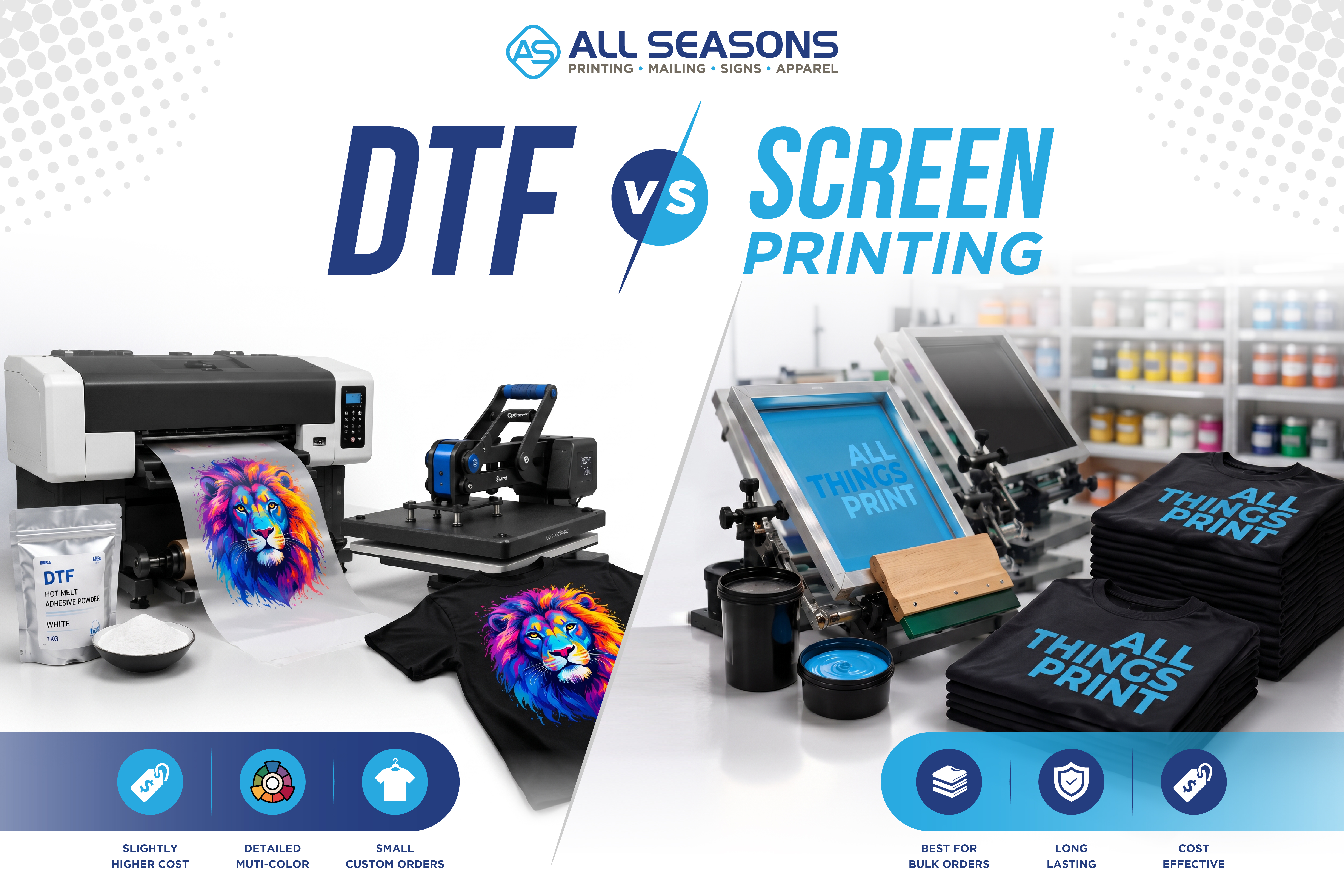
Choosing the right printing method is an important decision when producing custom apparel. The printing process affects the appearance of a design, color quality, durability, texture, production time, and overall cost. Two of the most widely used methods for apparel decoration are DTF printing and screen printing.
DTF, or Direct-to-Film printing, has become increasingly popular because it can reproduce detailed, full-color artwork and is suitable for many short- and medium-run projects. Screen printing, meanwhile, remains a trusted method for producing durable, bold apparel graphics, particularly when large quantities of the same design are required.
So, which is better: DTF printing or screen printing?
There is no universal answer. The better method depends on the artwork, quantity, garment material, colors, desired print appearance, budget, and purpose of the apparel.
This guide explains what DTF printing is, what screen printing is, how both processes work, why businesses use each method, where each method performs best, how they compare in color quality and durability, and which printing method may be right for custom logo apparel.
What Is DTF Printing?
DTF stands for Direct-to-Film printing. It is a digital apparel printing process in which a design is printed onto a specialized transfer film and then transferred onto fabric using heat and pressure.
Unlike traditional screen printing, DTF does not require a separate physical screen for every color in the artwork. Instead, the design is prepared digitally and printed using a specialized DTF printer.
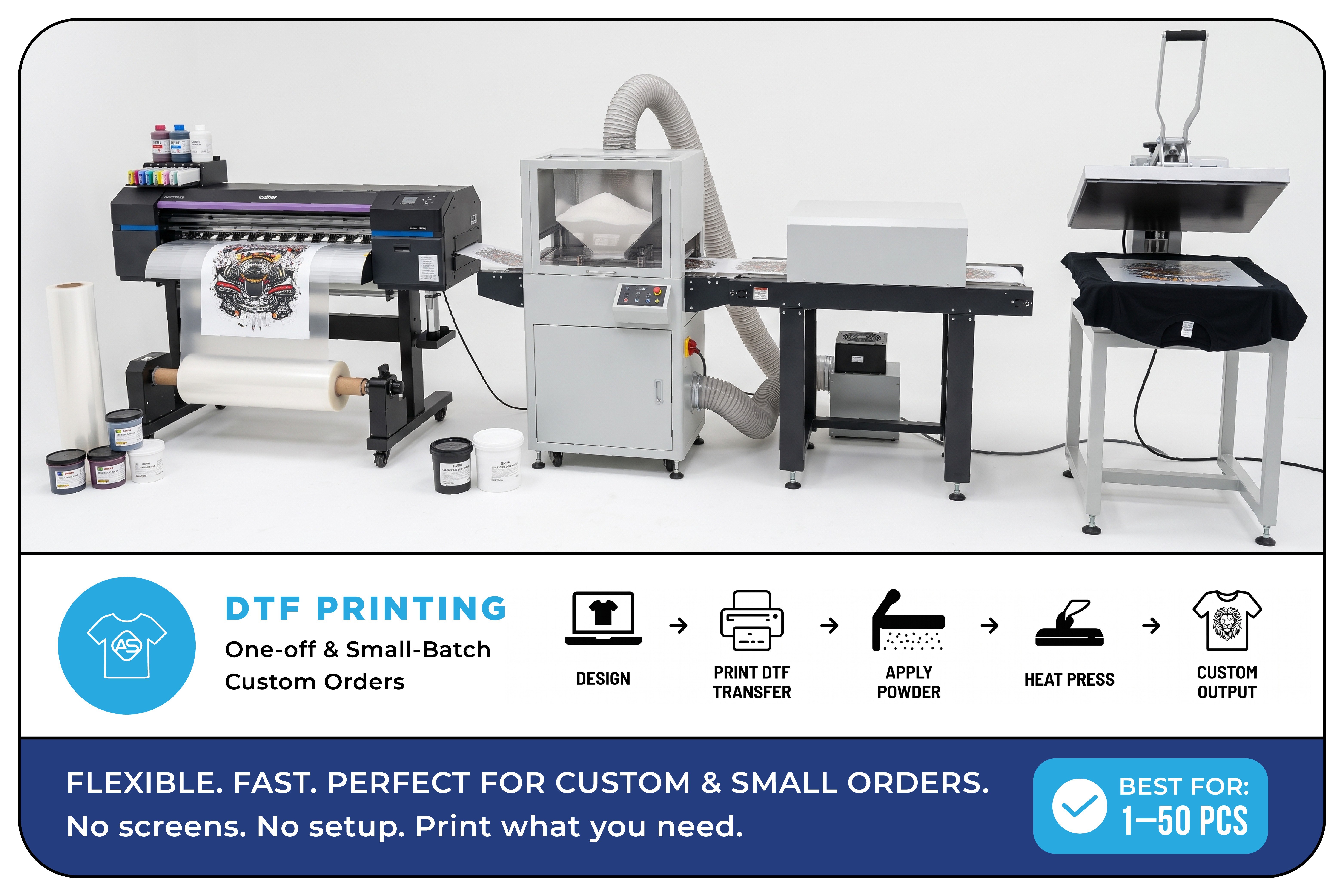
A typical DTF printing system uses CMYK inks and white ink to reproduce artwork. The printed design receives a hot-melt adhesive powder, which is then cured. The finished transfer is placed onto the garment and applied using a heat press.
This process makes DTF particularly useful for designs containing multiple colors, gradients, fine details, photographs, illustrations, and personalized elements.
Why Has DTF Printing Become Popular?
One of the biggest advantages of DTF is its flexibility.
Traditional printing methods can become more complicated when artwork contains many colors or highly detailed elements. DTF uses a digital workflow, allowing complex artwork to be prepared and reproduced without creating an individual screen for every color.
This makes DTF useful for custom apparel printing, promotional clothing, employee shirts, event merchandise, personalized garments, and smaller apparel orders.
DTF is also useful when the same business needs several different designs rather than hundreds of identical garments.
What Is DTF Transfer Printing?
DTF transfer printing refers to the process of printing artwork onto transfer film and then moving that artwork onto a garment.
The transfer acts as an intermediate carrier between the printer and the fabric. Instead of printing ink directly onto the shirt, the artwork is first created on the film and then applied to the garment with controlled heat and pressure.
This distinction is important because DTF is not simply another form of direct-to-garment printing. The artwork is printed onto film first, and the adhesive layer helps bond the design to the fabric.
DTF transfers are commonly used for T-shirt printing, hoodie printing, workwear, promotional apparel, team clothing, branded uniforms, and personalized garments.
How Does the DTF Printing Process Work?
The DTF printing process involves several connected stages, and each stage has a purpose in determining the quality of the final print.
How Is Artwork Prepared for DTF Printing?
The process begins with digital artwork.
The design may contain a company logo, illustration, photograph, text, gradient, or combination of graphic elements. The artwork is prepared according to the required print dimensions and garment placement.
High-resolution artwork is important because the printing system reproduces the digital file. If the original artwork contains poor-quality images, missing details, or incorrect colors, the final print may not appear as intended.
Color management is also important. Digital artwork may be created using different color spaces, while the printer uses a specific ink configuration. Proper preparation helps produce more predictable results.
How Is the Design Printed onto Film?
After artwork preparation, the DTF printer prints the design onto a specialized PET transfer film.
The printer uses digital ink technology to reproduce the artwork. CMYK inks create the colors, while white ink provides opacity where required.
The use of digital printing allows DTF to reproduce complex color combinations without creating separate physical screens for every color.
This is one reason DTF is particularly useful for detailed artwork and full-color designs.
Why Is White Ink Used in DTF Printing?
White ink plays an important role when printing designs intended for dark or colored garments.
Without an appropriate white underbase, colors can lose their visual strength when placed against a dark fabric. The white layer creates an opaque foundation that helps the printed colors remain visible.
This is particularly important for colorful logos, illustrations, photographs, and designs containing lighter colors.
The amount and placement of white ink must be controlled carefully. Too much white ink can affect the feel and appearance of the transfer, while insufficient coverage can reduce color strength.
Why Is Adhesive Powder Added?
After the artwork is printed, a special hot-melt adhesive powder is applied to the printed area.
The adhesive is essential because it creates the bonding layer between the printed design and the garment.
The powder must cover the appropriate printed areas consistently. Uneven application can affect how the transfer bonds to the fabric.
How Is the DTF Adhesive Cured?
The adhesive powder is then cured using controlled heat.
Curing is an important part of the process because the adhesive needs to reach the appropriate condition before the transfer is applied to the garment.
Temperature, time, equipment, film, powder, and production conditions can all influence the result. Proper curing helps create a more consistent transfer.
How Is a DTF Transfer Applied to a Shirt?
Once the transfer is prepared, it is positioned on the garment.
A heat press applies controlled heat and pressure for a specified amount of time. The heat activates the adhesive, allowing the printed transfer to bond with the fabric.
After the appropriate pressing procedure, the transfer film is removed according to the specifications of the particular transfer system.
The result is a detailed printed design bonded to the garment.
What Is Screen Printing?
Screen printing is a traditional printing process in which ink is pushed through a mesh screen and stencil onto a surface.
For apparel printing, the screen contains an image of the area where ink should pass through. A squeegee moves across the screen, forcing ink through the open portions and onto the garment.
Screen printing has been used for decades and remains one of the most important methods for shirt printing and custom apparel printing.
Its continued popularity comes from its ability to produce strong colors, durable graphics, and specialty finishes while becoming increasingly efficient as order quantities increase.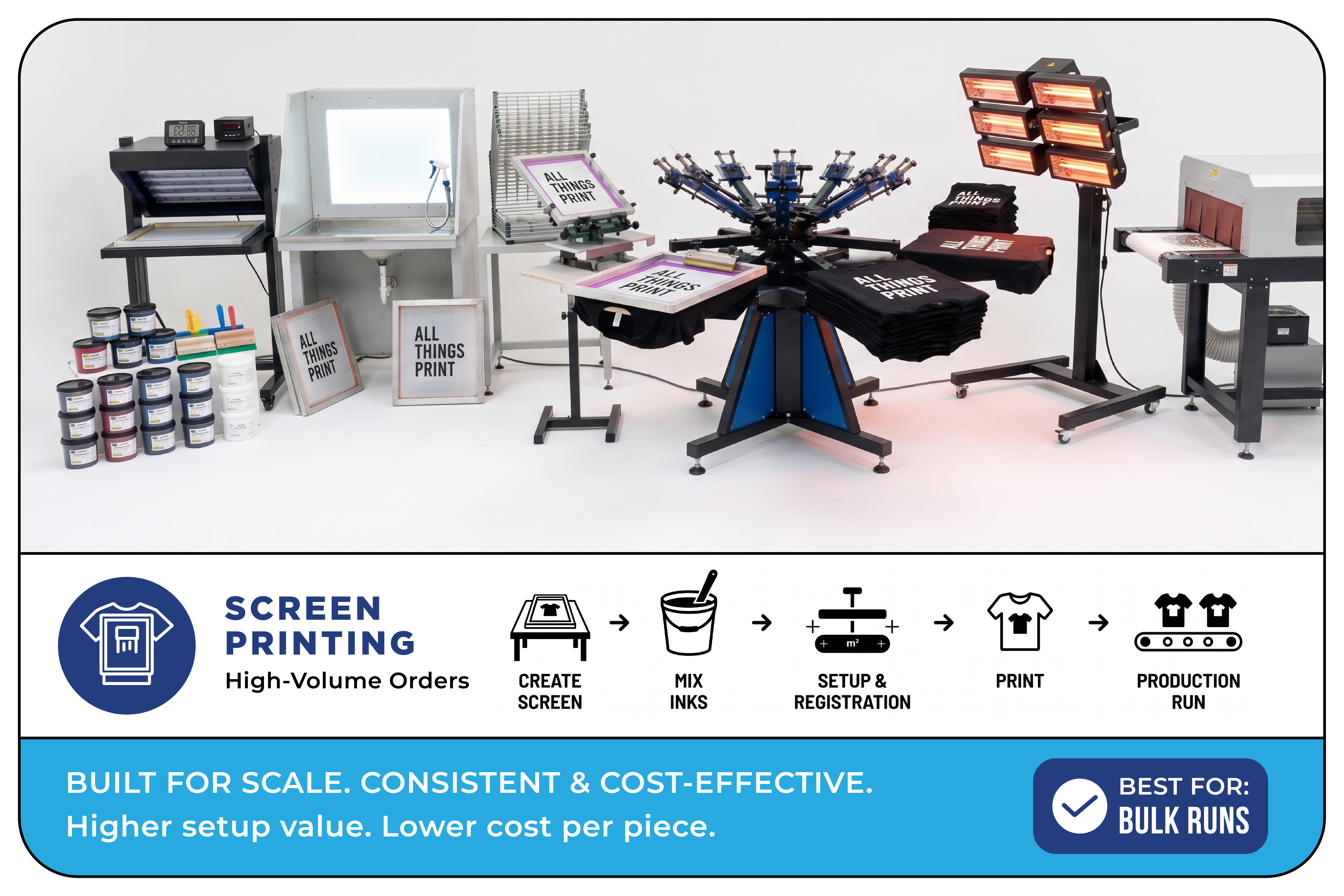
How Does the Screen-Printing Process Work?
Screen printing involves considerably more physical preparation than DTF because the artwork must be converted into printable screens.
How Is Artwork Prepared for Screen Printing?
The first stage is preparing the artwork for production.
Unlike a digital DTF workflow, screen printing generally separates the artwork according to its individual colors.
For example, a simple logo containing two colors may require two separate screens. A design with several spot colors can require additional screens.
This color separation is an important part of screen printing because each color is printed separately.
How Are Screens Created?
A mesh screen is coated with a light-sensitive emulsion.
The artwork is transferred to the emulsion through an exposure process. Areas corresponding to the design are opened so ink can eventually pass through the screen.
The result is essentially a stencil that controls where ink reaches the garment.
This screen preparation is one of the major differences between screen printing and DTF printing.
DTF prepares the artwork digitally and prints it onto film. Screen printing physically prepares the artwork as one or more screens.
How Is Ink Applied to the Garment?
Once the screen is prepared and positioned, the garment is placed on the printing surface.
Ink is applied to the screen and pulled across it with a squeegee. Pressure pushes the ink through the open areas of the stencil and onto the fabric.
If the artwork contains multiple colors, the garment must be accurately aligned with each corresponding screen.
Registration is therefore an important part of producing clean, professional multi-color screen prints.
Why Does Screen Printing Require Curing?
After printing, the ink must be properly cured.
Curing allows the ink to achieve the required physical properties and helps the finished print withstand normal use and laundering.
Incorrect curing can negatively affect durability. For professional apparel printing, controlling the curing process is therefore just as important as preparing the artwork and applying the ink.
DTF vs Screen Printing: What Is the Main Difference?
The fundamental difference between the two methods is how the design reaches the garment.
DTF printing uses a digital transfer process. The design is printed onto film, coated with adhesive, cured, and heat pressed onto the garment.
Screen
printing
applies
ink
directly
through
a
prepared
mesh
screen. Each
color
is
generally
handled
through
a
separate
screen
and
printing
stage.
Digital transfer process (printed on film, then heat pressed) | Ink pushed directly through mesh screens onto fabric |
Best for complex, full-color artwork, gradients, and photographs | Best for bold, solid-color designs and logos |
Flexible for small and medium runs | Highly efficient for large bulk orders |
No physical screens required — faster setup for varied designs | Requires separate screens for each color — longer setup |
Strong for personalized apparel (names, variations, event-specific designs) | Strong for repeat production of identical designs |
Print feel: noticeable transfer layer depending on design size | Print feel: can be soft or textured depending on ink choice |
Durability depends on film, adhesive, curing, and press settings | Durability depends on ink deposit, curing, and garment material |
Commonly used for promotional apparel, employee shirts, event merchandise, personalized clothing | Commonly used for uniforms, sports apparel, campaign merchandise, bulk promotional shirts |
This difference influences setup, artwork flexibility, color reproduction, production economics, print feel, and the type of project for which each method is best suited.
Why Is DTF Better for Complex Artwork?
Complex artwork can contain gradients, photographs, shadows, fine lines, multiple colors, and subtle transitions.
With DTF, this type of artwork can be prepared digitally and printed directly onto transfer film. There is no need to create a physical screen for every individual color contained in the design.
This makes DTF particularly attractive for full-color logos, detailed illustrations, photographic artwork, and personalized designs.
Screen printing can reproduce complex artwork, but the production process may require additional color separations, screens, registration, and specialized printing techniques.
Therefore, when artwork complexity is a major consideration, DTF can provide greater production flexibility.
Why Is Screen Printing Better for Certain Large Orders?
Screen printing has a major advantage when producing large quantities of identical garments.
The preparation involved in creating screens requires time and labor. However, once the screens are prepared and the press is set up, the same design can be reproduced efficiently across a large number of garments.
This makes screen printing especially attractive for bulk orders.
For example, a company ordering hundreds of shirts with the same one- or two-color logo may find screen printing highly suitable.
The initial setup is distributed across the larger quantity, which can improve production efficiency.
DTF vs Screen Printing for Small Orders
DTF is often a practical solution for small apparel orders because it does not require the same physical screen preparation associated with traditional screen printing.
If a customer needs a small number of shirts with a detailed full-color design, creating multiple screens may not be the most efficient approach.
A digital DTF workflow allows the artwork to be prepared and transferred without extensive screen setup.
This makes DTF particularly useful for short-run apparel, personalized clothing, small business merchandise, event shirts, and limited promotional campaigns.
DTF vs Screen Printing for Large Orders
When order quantities become larger, the economics can change.
Screen printing can become increasingly efficient because the setup work is spread across many garments.
A simple design printed on hundreds of identical shirts is a classic example of where screen printing can be highly effective.
DTF can also produce large orders, particularly when the artwork is complex or the order includes multiple variations. However, the best option depends on production capacity, artwork, garment requirements, quantity, and pricing.
There is therefore no universal quantity at which DTF suddenly becomes better or worse. The correct decision should be based on the complete project.
Which Has Better Color Quality: DTF or Screen Printing?
Color quality is an important consideration when comparing DTF and screen printing.
DTF has a strong advantage when artwork contains a broad range of colors, gradients, photographic details, and subtle transitions.
Because DTF is a digital printing process, it can reproduce complex artwork without requiring a separate physical screen for every color.
Screen printing, however, can produce exceptionally strong and vibrant solid colors. This makes it particularly effective for bold logos and graphics using a limited number of colors.
Therefore, asking which method has “better color quality” is not enough.
The better question is what type of color reproduction does the artwork require?
A detailed photographic design may favor DTF, while a bold two-color corporate logo may be exceptionally well suited to screen printing.
What Is CMYK in DTF Printing?
CMYK refers to Cyan, Magenta, Yellow, and Key/Black.
These four ink colors are used in digital printing to reproduce a wide range of colors.
DTF printers commonly use CMYK inks along with white ink. The digital printing system combines the available ink colors to reproduce the appearance of the artwork.
White ink is especially important when the design needs to be printed onto darker garments.
Understanding CMYK is important for businesses ordering high-quality prints because the colors displayed on a computer screen are not always reproduced identically on physical materials.
Proper artwork preparation and color management can help achieve more predictable results.
Which Has Better Print Feel: DTF or Screen Printing?
Print feel refers to how the printed area feels when someone touches the garment.
DTF creates a transfer layer on top of the fabric. Depending on the design size, ink coverage, transfer materials, and production settings, the print may have a noticeable surface feel.
Screen printing can provide a different hand feel depending on the ink system and the amount of ink deposited.
Traditional screen printing can produce relatively soft prints when appropriate inks and techniques are used, while specialty inks can intentionally create raised, textured, metallic, reflective, or other effects.
Therefore, if print feel is a major priority, the specific ink and production method should be discussed rather than comparing DTF and screen printing only by name.
Which Printing Method Is More Durable?
Both DTF and screen printing can produce durable apparel graphics when the correct materials and production procedures are used.
DTF durability depends on the quality of the film, ink, adhesive powder, curing process, heat-press settings, garment material, and washing conditions.
Screen-print durability depends on factors such as ink selection, ink deposit, garment material, curing, and production quality.
This means durability is not simply a matter of saying one technology always lasts longer.
A properly produced print from either method can perform well, while an improperly produced print can experience problems regardless of the technology used.
DTF vs Heat Transfer Vinyl: What Is the Difference?
DTF and Heat Transfer Vinyl (HTV) both use heat to apply graphics to garments, but their production methods are different.
HTV typically uses sheets or rolls of vinyl that are cut into shapes. Excess vinyl is then removed, or “weeded,” before the design is heat pressed onto the garment.
DTF is digitally printed onto transfer film and can reproduce complex full-color artwork.
HTV can be particularly useful for simple lettering, numbers, names, logos, and specialty vinyl effects. DTF is generally more suitable when artwork contains multiple colors, gradients, detailed illustrations, or photographic elements.
DTF vs Sublimation: Where Does Each Method Work Best?
Sublimation is another digital printing process, but it works differently from DTF.
Sublimation ink is transferred into suitable materials using heat. It is particularly associated with polyester fabrics and specially coated products.
Sublimation is widely used for sportswear, polyester apparel, mugs, promotional products, and certain all-over designs.
DTF, by comparison, uses a printed transfer and adhesive layer and can be suitable for a broader range of common garment materials when the correct transfer and application conditions are used.
The choice between DTF and sublimation therefore depends heavily on the material being printed and the desired result.
What Are the Benefits of DTF Printing?
The biggest benefit of DTF is flexibility.
A single digital workflow can accommodate detailed artwork, multiple colors, gradients, photographs, logos, and personalized graphics.
This makes DTF especially useful for businesses that do not always order hundreds of identical garments.
DTF also makes it easier to produce different versions of an apparel design. A business may need different employee names, event variations, customer-specific graphics, or multiple designs within the same order.
For modern custom apparel printing, this flexibility can be extremely valuable.
What Is the Benefits of Screen Printing?
Screen printing's biggest strengths are its production efficiency, strong color output, durability, and specialty ink capabilities.
It is particularly effective for businesses, organizations, schools, teams, events, and brands that need large quantities of the same apparel design.
Screen printing also offers a wide range of ink possibilities that can create specific visual and physical effects.
For large-volume apparel production, it remains a highly relevant printing technology despite the growth of digital printing.
Where Is DTF Printing Commonly Used?
DTF transfers are used in a wide range of apparel applications.
They can be used for company shirts, promotional apparel, hoodies, employee clothing, event merchandise, team apparel, personalized garments, workwear, and branded clothing.
For small businesses, DTF can also be useful for testing new apparel designs without committing to a very large production run.
This flexibility is one of the reasons DTF has become an important option in the custom apparel market.
Where Is Screen Printing Commonly Used?
Screen printing is frequently used for bulk promotional apparel, company uniforms, event shirts, school clothing, sports apparel, campaign merchandise, retail clothing, and branded workwear.
It is especially effective when the same design needs to be reproduced repeatedly.
For organizations ordering a large quantity of identical shirts, screen printing can provide a highly efficient production workflow.
What Is the Best Method for Custom Logo Apparel?
The best printing method for a custom logo depends on the logo itself and how the apparel will be produced.
A simple one-color company logo printed on several hundred shirts may be an excellent screen-printing application.
A detailed full-color logo with gradients or photographic elements may be better suited to DTF.
If employees require individually customized shirts with different names or graphics, DTF can provide additional flexibility.
This is why professional apparel printing decisions should begin with the artwork and production requirements rather than automatically selecting one technology.
What Is the Best Method for Printing Shirts?
There is no single best method for every shirt-printing project.
DTF is often an excellent choice when the design is complex, colorful, detailed, or personalized, particularly for small and medium quantities.
Screen printing is often a strong choice for larger orders featuring the same design, especially when the artwork contains a limited number of colors.
HTV can be appropriate for simple personalized designs, while sublimation can be ideal for suitable polyester garments and sublimation-compatible products.
The best method is the one that matches the garment, artwork, quantity, appearance, durability expectations, and budget.
How Does Printing Method Affect Print Marketing and Print Advertising?
Custom apparel can be more than clothing. It can also function as a mobile marketing tool.
A company logo printed on employee shirts can increase brand visibility when employees interact with customers or attend community events.
Promotional shirts can also support trade shows, local events, fundraisers, campaigns, and customer giveaways.
For print marketing and print advertising, the quality of the apparel graphic matters because the garment becomes a physical representation of the brand.
A poorly reproduced logo can make a business appear less professional, while a clean, well-produced graphic can reinforce brand recognition.
Choosing the right printing process is therefore part of maintaining consistent visual branding.
Conclusion: Should You Choose DTF or Screen Printing?
The comparison between DTF vs screen printing is not really about finding one technology that is better for every situation. Both methods have specific strengths, and the right choice depends on the requirements of the project.
DTF printing is an excellent option when flexibility, detailed artwork, full-color reproduction, personalization, and smaller production quantities are important. Its digital workflow makes it particularly useful for complex logos, photographs, gradients, illustrations, and customized apparel.
Screen printing remains an excellent choice when businesses and organizations need larger quantities of the same design, strong solid colors, specialty finishes, and efficient repeat production. Its long-established production process continues to make it an important option for professional shirt printing and custom apparel printing.
When selecting between DTF and screen printing, consider the artwork first. Then evaluate the garment material, quantity, color requirements, print size, desired print feel, durability expectations, production timeline, and budget.
For businesses using apparel as part of print advertising, print marketing, promotional campaigns, employee branding, events, or customer outreach, selecting the appropriate printing process can make a significant difference in the final result.
All Seasons Signs and Printing in Joplin, MO can help businesses determine the appropriate printing approach for their custom apparel needs. Whether you need branded employee shirts, promotional T-shirts, event apparel, custom logo clothing, or other printed materials, the right production method should be selected according to the design, quantity, garment, and desired quality.
Ultimately, DTF and screen printing are complementary printing technologies. Understanding what each process does, why it is used, where it performs best, and how it affects the final product allows businesses to make a more informed decision and achieve the high-quality prints they need for professional branding and marketing.
Frequently Asked Questions
Answers to common questions about DTF and screen printing.
DTF means Direct-to-Film printing. It is a digital process in which artwork is printed onto specialized film before being transferred to a garment using heat and pressure.
DTF transfer printing is the process of digitally printing artwork onto transfer film, applying adhesive powder, curing the transfer, and heat pressing it onto fabric.
The artwork is prepared digitally, printed onto transfer film using CMYK and white ink, coated with adhesive powder, cured, and then applied to the garment using a heat press.
Screen printing uses a mesh screen and stencil to transfer ink directly onto a garment. Different colors generally require separate screens.
The artwork is separated into colors, screens are prepared, ink is pushed through each screen onto the garment, and the finished print is properly cured.
DTF is often better for detailed, full-color, personalized, and smaller apparel orders. Screen printing can be better for large quantities of identical garments and designs with fewer colors.
The answer depends on the logo. Detailed and full-color logos can be well suited to DTF, while simple logos printed in large quantities can be highly suitable for screen printing.
Yes. DTF can be used for T-shirts, hoodies, workwear, promotional clothing, event apparel, and many other garments when the transfer and application process are appropriate for the fabric.
Yes. Screen printing remains an effective option for business apparel, especially when a company needs a large quantity of shirts featuring the same logo or message.
DTF is particularly strong for detailed full-color artwork, gradients, and photographic images. Screen printing can produce excellent, strong solid colors and is particularly effective for bold spot-color graphics.
DTF is often more practical for small orders because it does not require the same screen setup process as traditional screen printing.
Screen printing can be highly efficient for large quantities of identical designs because the initial setup is distributed across many garments.
Need Custom Apparel for Your Business?
All Seasons Printing can help you choose the right decoration method for employee apparel, promotional clothing, events, teams, and branded merchandise.
Request a Quote